Conductor Karina Canellakis makes Proms history with stirring First Night
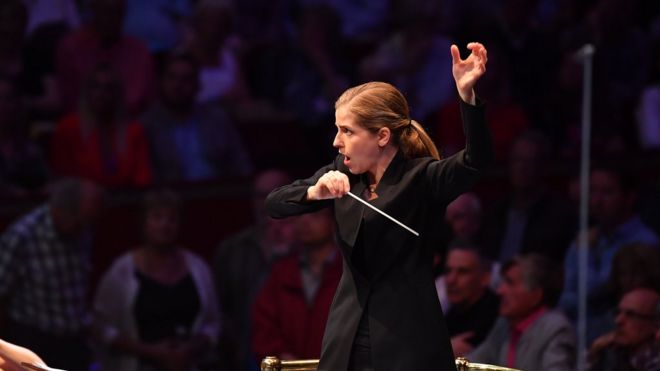 CHRIS CHRISTODOULOU
Karina Canellakis has made history, as the first woman to conduct the First Night of the BBC Proms.
The US musician led the BBC Symphony Orchestra and Chorus and BBC Singers in a stirring and dramatic programme culminating in Leos Janáček's utterly unique Glagolitic Mass.
The landmark performance came just two years after Cannellakis's conducting debut at the Proms.
"I'm honoured - and I'm very sweaty," she said after leaving stage.
The 38-year-old New Yorker started her career as a violinist after graduating from the Julliard School.
The seeds of her conducting career were sown at the BBC Proms in 2008, as she performed Mahler's emotional 6th Symphony as part of the Chicago Symphony Orchestra.
"I was playing second violin, and I played my heart out," she told BBC Radio 3, "and I remember just looking up and thinking I had never seen the ceiling so far away."
But it was British conductor Sir Simon Rattle who finally convinced her to swap the violin for the baton.
"He told me: 'You may not see many people that look like you up there, but I really think you could do this,'" she told the bachtrack website earlier this year.
"That was the thing that changed my pattern of thinking and gave me a little bit of a push towards... making music without the instrument in my hand, which in the beginning was quite terrifying."
On Friday night's evidence, she has ably grown into the role.
Her opening night kicked off with a complex, layered new work by Canadian composer Zosha Di Castri.
Long Is the Journey - Short Is the Memory was commissioned to mark the 50th anniversary of the Apollo 11 Moon landing, and explored everything from the dark, brooding exploration of space to man's first weightless steps on the lunar surface.
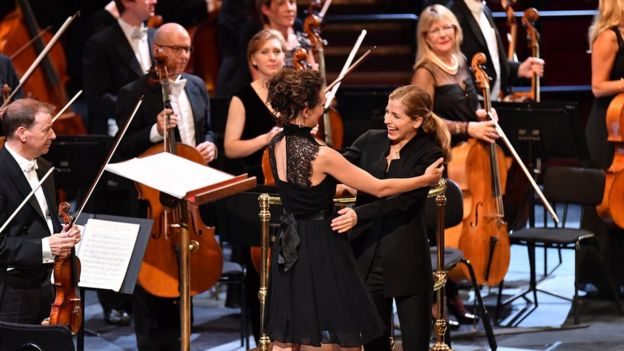 CHRIS CHRISTODOULOU
Di Castri managed to convey the eerie loneliness of that first moonwalk in a section where the orchestra rubbed together paper bags, blew compressed air into milk bottles, and scraped tuning keys across harp strings, while a lone oboe represented the awestruck wonder of astronauts Buzz Aldrin and Neil Armstrong.
The chorus, meanwhile, sang an evocative text by Chinese-British author Xiaolu Guo: "We stepped out and bounced, skipped, swang wide, set the flag on the silent lunar surface."
Researching the piece left a major impression on the composer, who had never before considered the monumental human effort behind the Moon landings.
"To be honest, it was something that I took as fact - that we've been to the Moon," she said. "This brought back the sense of awe."
The first half concluded with a lovingly-shaped rendition of Dvořák's The Golden Spinning Wheel, receiving its first-ever performance at the Proms.

Part two was devoted to Janáček's elemental Glagolitic Mass - one of the greatest 20th Century choral works.
A setting of a ninth-century liturgical text, it is essentially the atheist composer's hymn to nature.
"Always the scent of the moist forest - that was the incense," said the Czech musician. "I felt a cathedral grow before me in the vast expanse of the hills and the vault of the sky".
"It is as much pagan ritual as it is a mass," acknowledged Canellakis ahead of the concert, "and it switches drastically from one section to another."
Under her watch, the BBC Symphony Orchestra expertly navigated the shifting celestial and confrontational tones, while organist Peter Holder deservedly received an ovation after untangling the labyrinthine solo.
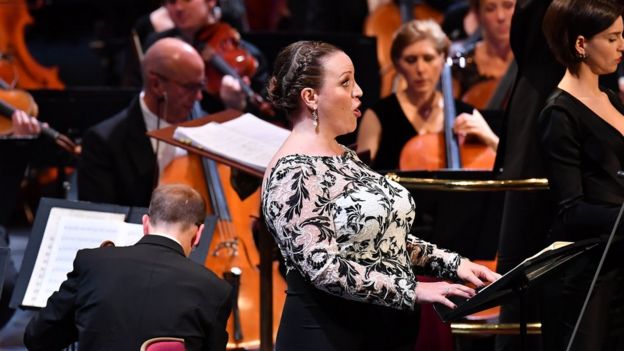 CHRIS CHRISTODOULOU
Soloists including tenor Ladislav Elgr and mezzo-soprano Jennifer Johnston were crisp and clear - despite being unclear on how the text should sound.
"Glagolitic was the precedent to the Cyrillic alphabet [and] the result is we don't really know how it's meant to be pronounced," she explained to BBC Radio 3.
"It's our best guess, along with academics who've given us some guidance."
The piece also highlighted a theme of the 2019 Proms season, which is marking the 150th anniversary of the birth of Sir Henry Wood. The Proms founder-conductor presided over the premiere of the Glagolitic Mass at the Queen's Hall in 1930.
The modern-day Proms, of course, are based in the Royal Albert Hall - where more than 1,000 of Friday's concert-goers were "Prommers", who had queued all day in the rain to snap up "on the day" tickets for just £6.
For Canellakis, it is those concert-goers who give the festival its unique flavour.
"I love the enthusiasm of the audience here," she said. "It's not an eight-year-old whose grandma drags him to the opera and he falls asleep in the back row.
"These people have waited for hours to get tickets and many of them are standing through the whole performance - and you feel that, as a performer."
The conductor, who has played the Proms every year since taking up the baton, is guaranteed to be back - and could conceivably follow in the footsteps of Marin Alsop, who in 2013 became the first woman to helm the festival's iconic closing night.
The 2019 season continues until 14 September, with highlights including a sci-fi Prom, the premiere of a new work by Radiohead's Johnny Greenwood, and performances from cellist Sheku Kanneh-Mason and "the Queen of African music" Angelique Kidjo.
Born in New York City, of Greek and Russian background,[2] Canellakis grew up in a family of musicians. Her parents met as music students at the Juilliard School. Her father Martin became a conductor,[2] and her mother Sheryl became a pianist.[3] She studied violin as a youth, and her younger brother Nicholas studied cello.[4] She continued formal music studies at the Curtis Institute, where her teachers included Ida Kavafian, and graduated from Curtis in 2004.[5][6] As a violinist, she played as a substitute in the Chicago Symphony Orchestra, and was a guest leader with the Bergen Philharmonic Orchestra.[7]
From 2005 to 2007, Canellakis was a violinist with the Berlin Philharmonic Orchester-Akademie. Whilst in Berlin, Simon Rattle encouraged her growing interest in conducting. She formally studied conducting at the Juilliard School from 2011 to 2013, where her teachers included Alan Gilbert. She also studied conducting with Fabio Luisi, at the Pacific Music Festival.[5] In 2013, she was the winner of the Taki Concordia Conducting Fellowship.[8] From 2014 to 2016, she was the assistant conductor of the Dallas Symphony Orchestra. Early in her career in the Dallas post, in October 2014, she stood in as an emergency substitute for Jaap van Zweden with the Symphony No 8 of Shostakovich, without rehearsal.[1] Her work in contemporary music has included performing with and conducting the International Contemporary Ensemble (ICE),[9] and conducting the premiere of David Lang's chamber opera The Loser in September 2016.[10]
Canellakis made her European conducting debut in 2015 with the Chamber Orchestra of Europe, as an emergency substitute for Nikolaus Harnoncourt.[11] In 2016, she won the Georg Solti Conducting Award.[6] Her conducting debut at The Proms in September 2017 was also her debut with the BBC Symphony Orchestra (BBC SO).[12] Also in September 2017, Canellakis made her first guest-conducting appearance with the Berlin Radio Symphony Orchestra (RSO Berlin).[13]
In March 2018, Canellakis guest-conducted the Radio Filharmonisch Orkest (RFO), with concerts in Utrecht and Amsterdam.[14] On the basis of this series of concerts, in May 2018, the RFO announced the appointment of Canellakis as its next chief conductor, effective with the 2019-2020 season, with an initial contract of 4 years.[15] This appointment marks Canellakis' first orchestral post. She is the first female conductor to be named chief conductor of the RFO, and the first female conductor to be named chief conductor of any Dutch orchestra.[15] In December 2018, Canellakis conducted the annual Nobel Prize concert with the Royal Stockholm Philharmonic Orchestra, the first female conductor to do so.[16] In April 2019, the RSO Berlin announced the appointment of Canellakis as its next principal guest conductor, the first female conductor named to the post, effective with the 2019-2020 season.[17] On 19th July 2019, she conducted the BBC Symphony Orchestra, BBC Chorus and BBC Singers in the First Night of the Proms at the Royal Albert Hall in London; the first woman to do so in the 125 year history of the Proms. [18]

No comments:
Post a Comment