Good morning, and welcome to the Essential California newsletter. It’s Wednesday, April 19.
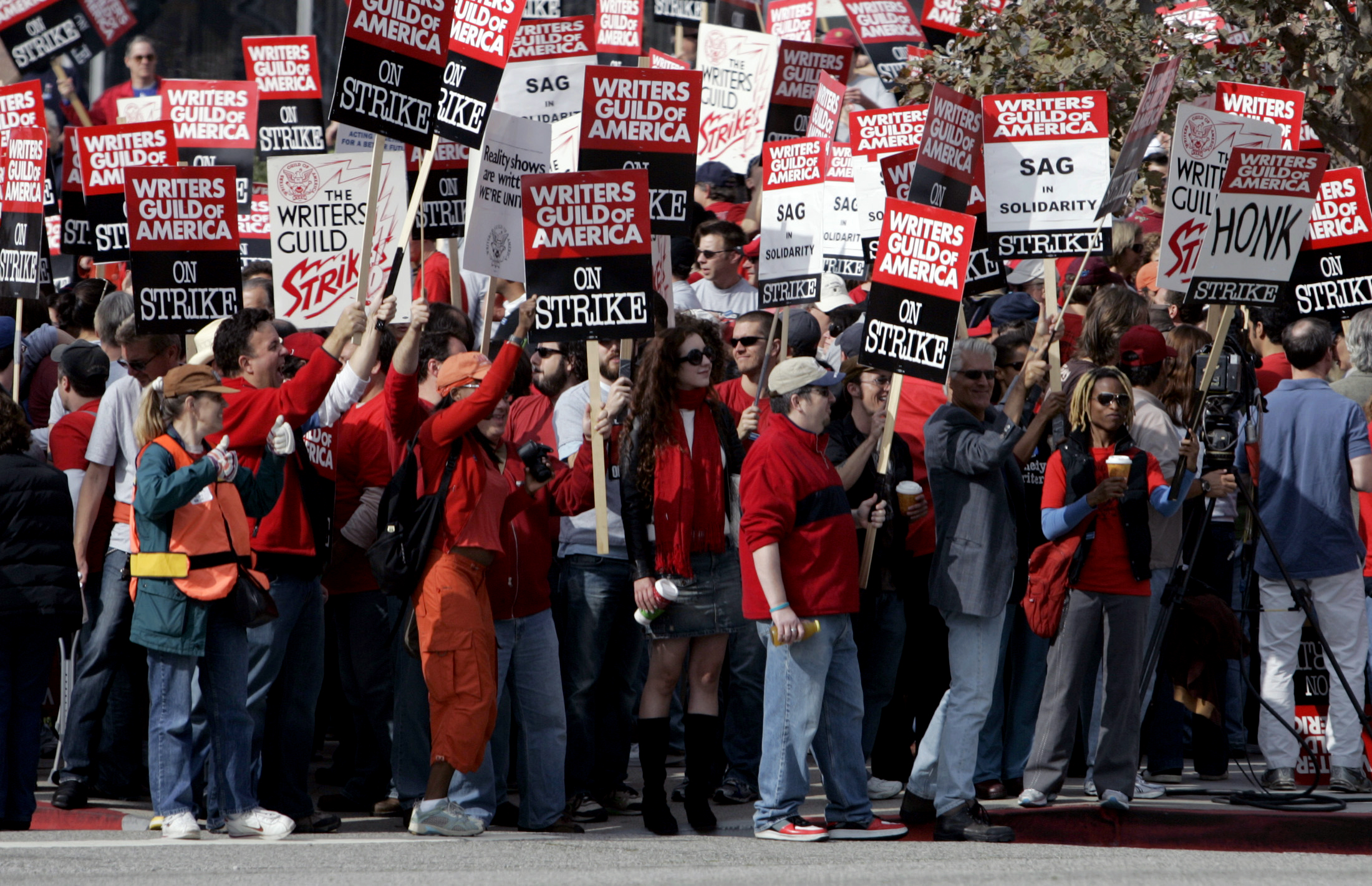
The Hollywood economic engine is one step closer to shutting down. On Monday, Writers Guild of America members voted by a historic margin — 98% to 2% — to approve a strike as negotiations between union leaders and the Alliance of Motion Picture and Television Producers stalled.
The alliance is made up of traditional studios like Walt Disney Co. and Warner Bros., but also includes the more recently added streaming giants Netflix, Amazon and Apple.
Writers are calling for higher wages and a full redesign of the residual payments process, which the age of streaming has thrown for a loop.
Their current three-year contract, which covers about 11,500 members, expires May 1. If the two sides can’t reach a deal by then, we could witness the first writer walkout in 15 years.
As thousands of writers and the major entertainment powerhouses prepare for the possibility of a work stoppage, here are four things to know about what’s happening and what’s next.
1) Streaming is at the heart of the fight
With network TV, cable channels, the big streaming services and smaller on-demand channels so new or niche you may not have heard of them (What is Tubi? Does anyone know?), there’s more to watch than ever before.
But that surge in content has depressed writer pay, WGA leaders argue. A recent union survey found that half of series writers now earn scale (the minimum episodic or weekly rate) compared with 33% during the 2013-14 season.

One key word you’ll read a lot in coverage of the possible strike is residuals. That’s the money writers traditionally earned when a show episode they wrote was re-aired on television.
But that traditional rerun structure doesn’t exist on platforms like Netflix. The residuals writers get for working on streaming shows — no matter how popular or acclaimed their work becomes — are a fraction of the broadcast model.

2) The impact of a writers’ strike would be felt beyond the production set
A work stoppage would quickly ripple through a major job sector and economic driver for the state. If the writers stop writing, there are no scenes to film, no sets to create, no actors to get camera-ready, no crews to feed. It also means less money for the state, which generates revenue through filming permits.
The 2007-2008 writer’s strike provides a glimpse at the possible economic impact, when California’s economy lost an estimated $2.1 billion.
A Milken Institute study conducted in the aftermath of that three-month strike projected a net loss of 37,700 jobs directly and indirectly tied to the entertainment industry.
The last strike also came amid the Great Recession. And though the current economic forecast isn’t as dire as it was 15 years ago, there are concerns that a similar downturn could materialize this year.
3) A strike could change your TV viewing options
What would a strike mean for your favorite shows?
Just like the last time, it would halt production and delay development. Daily and weekly programs, such as late night talk shows and “Saturday Night Live,” would disappear. You’d likely have to wait a while on the release of new shows or new seasons still in production.
Despite some of the chatter on Twitter, the last strike didn’t create so-called reality TV, though it did expand its on-air real estate. Times entertainment writers Meredith Blake and Yvonne Villarreal explained why:
Most of the producers who craft reality TV story lines are not affiliated with a union and will not be affected by a strike. The genre also tends to be cheaper and less time-consuming to produce than scripted TV, making it an ideal alternative during past work stoppages.
But a work stoppage of scripted shows would prove more complicated for reality TV production this time around, given how the genre has grown in the decade-plus since — and workers are growing more vocal about labor issues in the largely non-unionized workforce.
4) The will-they-won’t-they of the strike is further complicated by turmoil in the entertainment industry
Disney, Netflix, Warner Bros. and more have laid off thousands of workers amid an economic downturn rippling across the industry. Big firms are continuing to lose money on streaming — and now the belt-tightening is upon them.
“It’s going to be a tough environment for them to come to a deal quickly because of the dynamics with studios having to make some cost cuts,” David Smith, a professor of economics at Pepperdine University’s Graziadio Business School, told Times reporters last week. “We’re still in this uncertain period about where digital streaming is going to end up.”
Netflix Co-CEO Ted Sarandos recently addressed the strike at the company’s first-quarter meeting.
“We don’t want a strike,” he said, according to Deadline, adding: “If there’s a strike, and we want to work really hard to make sure we can find a fair and equitable deal so we can avoid one, but if there is one, we have a large base of upcoming shows and films from around the world.”



No comments:
Post a Comment