Good morning. It’s Thursday, Aug. 8. Here’s what you need to know to start your day.
“Google is a monopolist, and it has acted as one to maintain its monopoly.”
So ruled U.S. District Judge Amit Mehta in a landmark antitrust decisionagainst the Mountain View-based tech titan.
Regulators argued Google maintained its web search dominance by paying billions to browser developers, phone manufacturers and wireless carriers in exchange for pre-loading Google as their products’ default search engine. When was the last time you looked something up not via Google search?
“The much-anticipated decision marks a significant victory for federal regulators trying to rein in the power of Big Tech and could send shock waves through the tech world,” my colleague Samantha Masunaga reported this week. “Other firms, including Apple, Meta and Amazon, also face federal antitrust lawsuits.”
Attorneys general in several states, including California, joined the federal lawsuit against Google, first filed in October 2020.
“As the fifth largest economy in the world, California has a special interest in protecting a landscape where competition and innovation will flourish,” state Atty. Gen. Rob Bonta wrote in a statement. “This historic win sets the tone for what we as a country and state will not allow.”
A case that ‘puts the world on notice’
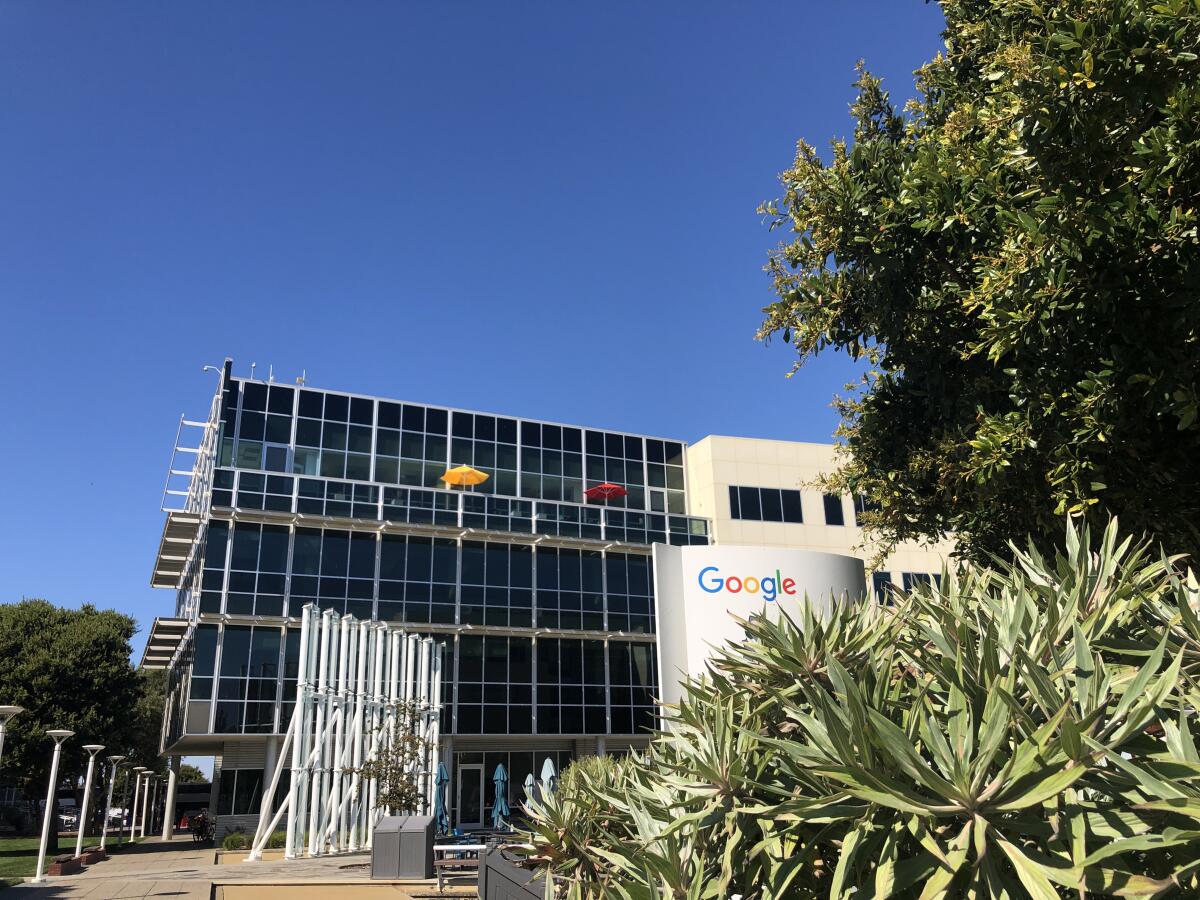
A Google office on the company’s Mountain View campus. (Brian Contreras / Los Angeles Times)
The outcome marks a “watershed moment,” said Randy Stutz, president of the American Antitrust Institute, which advocates for strong enforcement of antitrust laws.
“You don’t often see cases against firms in the top 10 in market cap go to trial and get a verdict like this,” he said. “This really puts the world on notice that these cases need to be taken seriously and that these enforcers have some strong arguments — winning arguments — to back up their claims.”
Stutz noted that the ruling doesn’t fault Google for building a superior search engine that paved the way for its web browser dominance.
Rather, the case focused on Google’s “monopoly maintenance,” he explained, or “what it’s done since then to preserve its dominance and prevent competition from emerging.”
The last monopolization case of this magnitude was the antitrust lawsuit brought against Microsoft nearly 25 years ago, according to Stutz, which faulted that company’s tactics to maintain its dominance in personal computer software.
What does this mean for Google?
For the moment, nothing. Judge Mehta’s decision was one phase of the proceedings, but there’s still a remedy phase, which will outline steps for Google to take in order to loosen its monopolizing grip in the eyes of the law.
It’s unclear exactly what those steps would be.
The company meanwhile plans to appeal the ruling.
“This decision recognizes that Google offers the best search engine, but concludes that we shouldn’t be allowed to make it easily available,” Kent Walker, president of Google Global Affairs, said in a statement. “As this process continues, we will remain focused on making products that people find helpful and easy to use.”
Those upcoming proceedings could take awhile, Stutz said, which highlights one “real drawback” of antitrust laws: Cases move slowly, while technology moves fast.
What could this mean for internet consumers?
In theory, it could mean fewer web browsers and mobile devices come with Google as the default web search option, opening the door to competition. Remember Bing? How about Yahoo?
Because right now, Google search’s market share is nearly a full pie, Samantha noted in her reporting:
“In 2009, 80% of U.S. web searches went through Google. By 2020, that figure was nearly 90%, according to the ruling. Almost 95% of mobile searches used Google.”
Stutz said the ruling opens the door for other companies to compete with Google and bring innovation to “what’s become a very stagnant market.” That, ideally, gives consumers more options and better experiences.
“It’s incredibly important right now that we create room for competition and room for the best and the most innovative products to reach customers [and] advertisers and have a chance,” he said.
The search engine market is already in the midst of a potential shakeup. Established companies like Google and OpenAI, along with startups, are integrating AI or launching AI-powered search engines, though some havehad a rough start.
Today’s top stories

Democratic presidential candidate U.S. Vice President Kamala Harris and Democratic vice presidential candidate Minnesota Gov. Tim Walz appear together during a campaign event at Girard College in Philadelphia. (Andrew Harnik / Getty Images)
The Kamala Harris ticket
California politics
Climate & environment
Courts & crime
Business
Science & medicine
Intuit Dome
More big stories
Get unlimited access to the Los Angeles Times. Subscribe here.


No comments:
Post a Comment