Good morning. Here’s what you need to know to start your Monday.
California’s bullet train could go from delayed to derailed
President Trump has long voiced dissatisfaction with California’s bullet train project, recently vowing to investigate and citing cost overruns for the multibillion-dollar effort to connect Los Angeles and San Francisco via high-speed rail.
When California voters approved an initial $9 billion in funding for the project back in 2008, officials estimated the system would be fully built and running trains by 2020. But the budget for the project has since ballooned, and the hoped-for completion timeline has shifted by more than a decade.
Last week, Trump’s Transportation secretary, Sean Duffy, announced the launch of a compliance review that will look at $4 billion promised to the project by the Biden administration, as well as consider future federal funding.

Transportation Secretary Sean P. Duffy speaks Thursday at a news conference at Union Station. (Allen J. Schaben / Los Angeles Times)
“We can’t just say we’re going to give money and then not hold states accountable to how they spend that money — how they spend it per the agreements that they made with the federal government,” Duffy said during a news conference at Union Station in downtown Los Angeles. “If California wants to continue to invest, that’s fine, but we in the Trump administration are going to take a look at whether this project is worthy of a continual investment.”
With federal assistance in question, project officials and state leaders are voicing their intent to keep moving forward, though the project may need private sector investments to stay on track.
After more than a decade lag on land buying, delayed environmental reviews and legal challenges, rail officials now say they hope to have a project connecting Merced, Fresno and Bakersfield ready sometime between 2030 and 2033.
“Although the entire line between San Francisco to Los Angeles was environmentally cleared for construction last year, the project has faced massive challenges,” Times reporter Colleen Shalby wrote last week. “The budget is roughly $100 billion more than the authority’s original $33-billion estimate, and leaders have yet to identify tens of billions of dollars needed to finish it.”
In a statement, Ian Choudri, chief executive of the High-Speed Rail Authority, said he welcomed the new investigation.
“With multiple independent federal and state audits completed, every dollar is accounted for, and we stand by the progress and impact of this project,” the statement read. “This investment has already generated $22 billion in economic impact, primarily benefiting the Central Valley.”

Protesters voice their opposition during Duffy’s visit to Union Station. (Allen J. Schaben / Los Angeles Times)
The embattled project does have vocal supporters in the Golden State, as evident during Duffy’s Union Station stop. The event was blocked off from the transit hub, but dozens of protesters gathered on the opposite side of black curtains, shouting, “Build the rail!” as Duffy and some state Republicans spoke.
California’s planned bullet train is also in the crosshairs of Elon Musk’s Department of Government Efficiency, and the billionaire owner of Tesla Motors has long railed against the project.
He previously floated the idea of a “hyperloop” system from San Francisco to L.A., which his official biographer later noted was born of his hatred of California’s already approved bullet train. Back in 2018, Musk proposed digging a tunnel to ferry fans to Dodger Stadium on “electric skates.” That project never happened. The big achievement thus far of Musk’s Boring Co.? Less than two miles of tunnel under Las Vegas — or what transportation writer Alissa Walker aptly refers to as “car holes” in her recent Torched newsletter.
Though he’s been critical of California’s management, Trump has expressed an interest in high-speed rail. During a livestreamed conversation with Musk in August, he said it “doesn’t make sense” that the U.S hasn’t advanced its rail systems to the level seen in Japan.
Leaders of the transportation labor group AFL-CIO pointed out the president’s complaint in a recent statement of their own.
“We agree with him that it is past time for our country to have these kinds of modern, efficient, high-capacity transportation systems,” wrote Greg Regan and Shari Semelsberger, president and secretary-treasurer of the AFL-CIO, respectively. “We also realize that those nations with bullet trains are ones who prioritized and paid for them. We are the wealthiest country in the world, and Americans deserve world-class trains right here at home.”
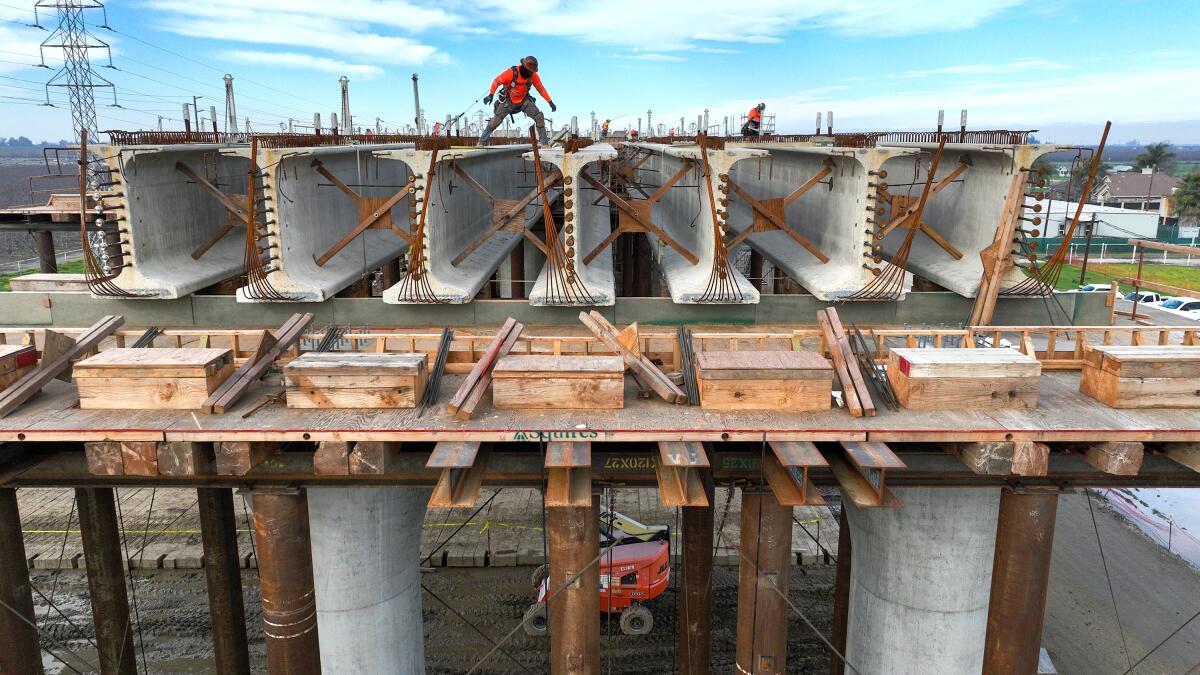
Crews work on the California High Speed Rail in Kings County early in 2024. (Robert Gauthier / Los Angeles Times)
So why don’t we have nice trains? Mainly because the state and local governments did not prioritize them for decades.
“Between 1949 and 2017, the federal government invested only $10 billion in high-speed rail with $4 billion of that dedicated to the California project, compared to investments of $777 billion in aviation and over $2 trillion in highways,” former Transportation Secretary Ray LaHood wrote in a guest commentary for CalMatters in 2023.
Giovanni Circella, a transportation planning engineer and director of the 3 Revolutions Future Mobility Program at UC Davis, broke down the benefits of electric high-speed rail for me in 2023:
- They’re more environmentally friendly (currently, just 2% of transportation emissions come from rail travel, while cars and trucks account for more than 80%).
- They’re more efficient in terms of moving people compared to all the space needed to move (and park) all our cars.
- They’re safer than driving, which now kills roughly 40,000 people in the U.S. annually.
- They can be “extremely competitive in shrinking the distance between cities,” Circella said, which can create more economic opportunities than our road network alone.
Today’s top stories

(Brian van der Brug / Los Angeles Times)
Health and environment
State and local politics
SAG Awards 2025
What else is going on


No comments:
Post a Comment