The laser technology is transforming archaeology by revealing the scope of ancient civilizations.
In recent years, archaeologists have turned to lasers in order to unearth previously hidden ancient civilizations.
A laser technologyknown as lidar— short forLight Detection and Ranging— beams tens of thousands of laser pulses per second from planes or helicopters at the ground below, penetrating through thick, deep forest canopy. That provides researchers with data to create three-dimensional maps by digitally removing the vegetation, revealing human-built structures underneath.
Researchers have found hundreds of structures in areasonce thoughttoo inhospitable for human habitation. The aerial views help them understand how far these cities and villages stretched, which archaeologistsfound difficultto map before lidar.
From a Maya city to complex villages deep in theBrazilian Amazon, here are six previously unknown civilizations that were discovered through state-of-the-art lidar technology.
Maya pyramidal structures in the Yucatán Peninsula
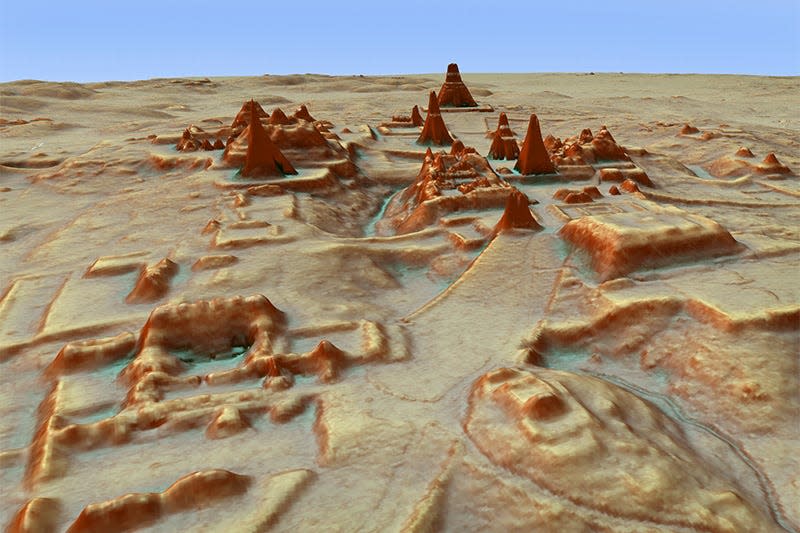
About 40 miles inside the dense vegetation of the Balamkú ecological reserve on Mexico's Yucatán Peninsula, researchers found theremains of a Maya city.
Based on pottery archaeologists found at the site, Maya people probably inhabited the city between 600 and 800 CE and perhaps earlier. Over about 123 acres, the city center contained 50-foot pyramidal structures, plazas, stone columns, and altars, according to the2023 study.
"Architecturally, it was truly massive," archaeologist Ivan Šprajc told theBBC. "So, it's clear this must have been a politically important center."
An estimated 6 to 8 million Maya people live throughout the Americas. Thus, the culture never disappeared, but Šprajc said such archaeological finds can help scientists understand what led to "a drastic demographic decline" by the 10th century.
A hidden 2,000-year-old Maya civilization in northern Guatemala
Using laser pulses, researchers detected a 2,000-year-old Maya civilization in the Mirador-Calakmul Karst Basin region of northern Guatemala with nearly 1,000 archaeological sites.
From their topographical maps of the area, they determined that the civilization consisted of more than 417 cities, towns, and villages spread across 650 square miles. They published their findings in 2022 in the journalAncient Mesoamerica.
The settlement had dozens ofball courtsand 110 combined miles of elevated limestone-and-clay causeways that allowed ancient Mayas to travel over wetlands and between different sites.
"They're the world's first superhighway system that we have," Richard Hansen, the study's lead author, toldCNN.
Nearly 500 long-lost Maya and Olmec ceremonial sites in Mexico
Lidar uncovered almost 500 ceremonial sites in the Olmec and Maya regions of Mexico.Inomata et al.
In 2021, researchers published astudydetailing how they hadused lidar to uncover478 Mesoamerican sites they estimated were between 2,000 and 3,000 years old.
The sites are spread across a 32,800-square-mile area in the Mexican states of Tabasco and Veracruz, where the Olmec and Maya civilizations flourished.
"It was unthinkable to study an area this large until a few years ago," Takeshi Inomata, an anthropologist with the University of Arizona who co-authored the study, saidin a press releaseat the time.
The finding helps archeologists connect the two cultures. The dates of construction and similarity of certain structures suggest that an Olmec site, San Lorenzo, provided inspiration for some Maya monuments.
61,480 previously unknown structures hidden under the dense Guatemalan jungle
In2018, researchers explained how they used laser technology to map Petén, Guatemala, where Maya people once lived.
They discovered 61,480 long-lost roads, foundations for houses, military fortifications, and elevated causeways. They all date back to 650 and 800 CE, during thelate Classic period.
The researchers estimate as many as 11 million people could have lived in the interconnected cities.
"Seen as a whole, terraces and irrigation channels, reservoirs, fortifications, and causeways reveal an astonishing amount of land modification done by the Maya over their entire landscape on a scale previously unimaginable," Francisco Estrada-Belli, an anthropologist at Tulane University and co-author of the study, said in apress release.
81 earthworks, including fortified villages and roads, deep in the Amazon rainforestAn aerial photo of an earthwork mound constructed over 500 years ago in the Amazon.
Courtesy of Jonas Gregorio de Souza/ University of Exeter
In Brazil's Mato Grasso region,archaeologists usinglidar foundevidenceof 24 sites with 81 earthworks, which included interconnected roads and fortified villages built on mounds.
They believe the structures may have supported a complex civilization with up to 1 million people between the years 1250 and 1500 CE.
Some of the geoglyphs, as archaeologists call the sites carved into the Earth, were up to a quarter of a mile across.
Hundreds more sites may be hidden in the jungle in a "continuous string of settlements," Jonas Gregorio de Souza, the paper's lead author, toldThe Wall Street Journalin 2018.
"These people were combining small-scale agriculture with management of useful tree species," de Souza toldThe Washington Post. "So it was more a sustainable kind of land use" than current land-clearing practices.
A wide-ranging ancient civilization buried in the Bolivian Amazon
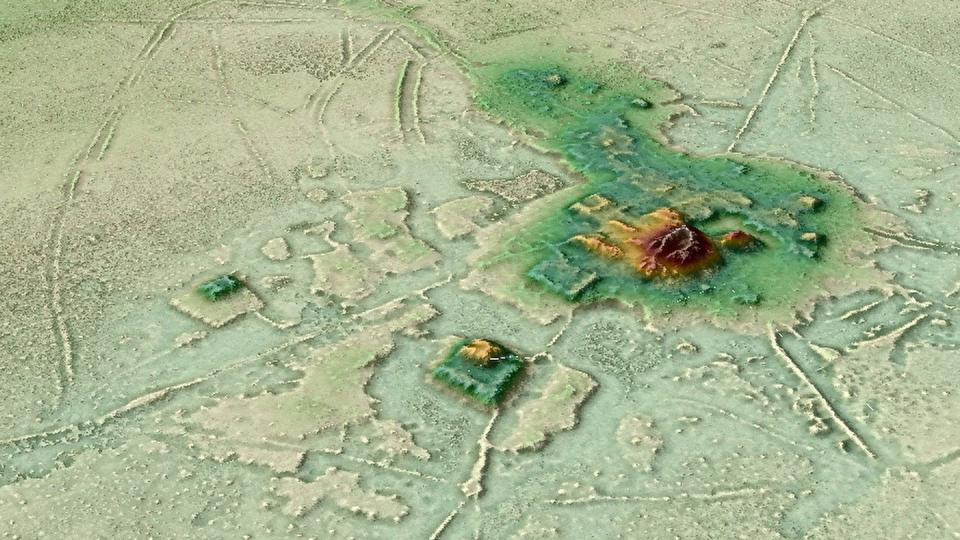
In what is now Bolivia, lidar revealed the hidden ruins of 26 Indigenous settlement sites, 11 of which were new discoveries, that thrived in the Amazon rainforest more than 600 years ago.
"Our results put to rest arguments that western Amazonia was sparsely populated in pre-Hispanic times," researchers wrote in the journalNature.
People from the Casarabe Culture created canals, stepped platform buildings, and 72-foot conical pyramids, which occupied an area of approximately 1,700 square miles between 500 and 1,400 CE. The lidar maps helped the researchers see how the spread-out settlements fit together.
Heiko Prümers, a co-author of the study, theorized that the Casarabe may have left the settlement due to lack of rainfall. "We know that there were severe droughts in the Amazon regions several times in history," he toldSmithsonian Magazinein 2022. "That might have happened to this culture as well."


No comments:
Post a Comment