Good morning, and welcome to the Essential California newsletter. It’s Monday, Aug. 21.
Tropical Storm Hilary — downgraded from a hurricane — hit the Golden State last night, bringing heavy rain, high winds, flooding, mudslides, road closures and other hazards across southern counties. The last time a tropical storm reached California’s coast was probably a little before your time: World War II had just started.
So yeah, it’s been awhile. Here‘s what to know.
The storm’s path
The storm made landfall in Mexico early Sunday. At least one person reportedly drowned in the town of Santa Rosalia on the Baja California peninsula.
The system continued to move north, bringing heavy rain to San Diego County, particularly the inland region.
The storm continued north, dousing Los Angeles, Orange, Riverside, San Bernardino and Ventura counties throughout the day and early evening.
The trail of Hilary took an interesting turn Sunday night, as the storm made a trek from the Inland Empire to the heart of Los Angeles.
By 11 p.m. Sunday, the National Hurricane Center put Hilary’s center back where it was originally expected to be located — in the Owens Valley, somewhere roughly between Ridgecrest and Lone Pine.
Key impacts
Flooding is the big threat on residents’ and officials’ minds. Forecasters said the storm was expected to bring a potentially historic amount of rainfall.
The National Hurricane Center predicted 2 to 4 inches of rain in most areas, with 4 to 6 inches in the mountains. Daily rainfall records were shattered in downtown Los Angeles, at Long Beach Airport and at Los Angeles International Airport.
A flash flood warning was issued midday Sunday for much of L.A. County and parts of Ventura, San Bernardino, Riverside and Kern counties.
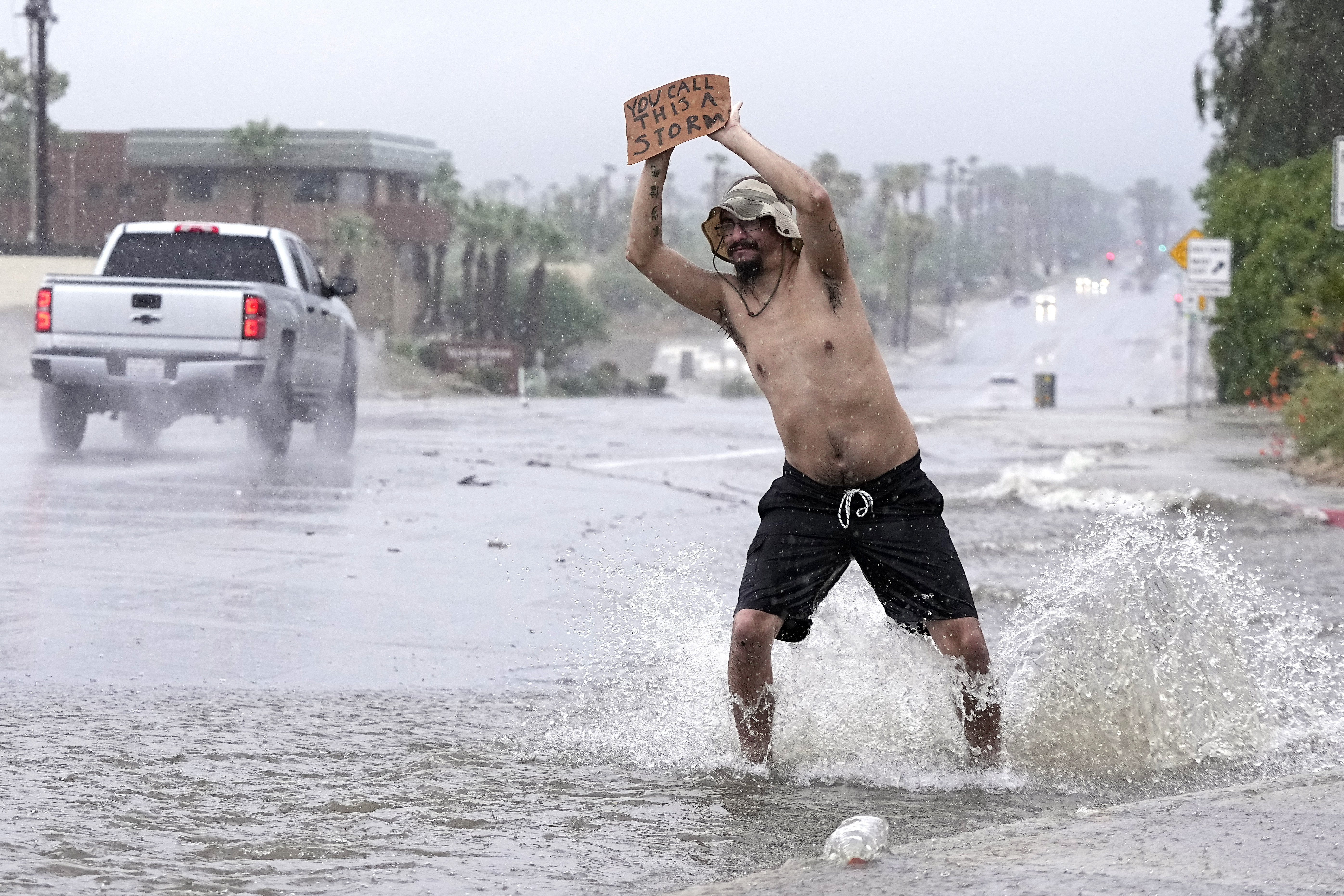
Flooding and mudslides were reported in the Antelope Valley, which had received more than 2 inches of rain before noon Sunday. In San Diego County, the storm toppled trees, sent boulders rolling downhill, flooded intersections and led to the cancellation of some flights. Photos and videos from the Coachella Valley also documented heavy flooding on roads.
Forecasters warned of “LIFE THREATENING FLOODING” for the area between Point Dume and Point Mugu and in parts of Camarillo, Westlake Village, Somis and Spanish Hills. (You really don’t want to see the weather service sharing an all-caps post on social media that begins “HEADS UP!!!!!”)
Weather service officials reported cars were stuck on flooded roads in the Spanish Hills area, and fire officials had been conducting swift water rescues.
Meteorologists warned there could be substantial, dangerous flooding in parts of San Bernardino and Inyo counties, with Death Valley and Morongo Basin expected to be hit hardest.
How did California respond?

Surfers ride big waves churned up by Tropical Storm Hilary at Seal Beach on Sunday. (Dania Maxwell / Los Angeles Times)
With the threat of flooding, landslides and rip currents off the coast, Gov. Gavin Newsom declared a state of emergency Saturday evening. Some counties and local governments issued their own emergency declarations Sunday, including Palm Springs.
Many residents (including me) received an emergency alert on their phones Sunday, announcing a flash flood warning was in effect until 7:45 p.m. Later in the evening, another alert announced the warning had been extended until 3 a.m. Monday.
State beaches in San Diego and Orange counties were closed. Sandbagging stations opened in communities from the coast to the desert as residents prepared to keep water out of their homes and businesses.
Elsewhere, many Californians seemed to treat it like a typical Sunday, plus an umbrella. Disneyland was open, though the theme park did announce its Anaheim parks would close one hour earlier. Surfers took advantage of the storm surge to catch some big waves.
The Red Cross opened several shelters in San Diego, Orange, Riverside, San Bernardino and Imperial counties.
Earthquake in Ojai
As if a historic storm making its way through the Golden State weren’t enough, a 5.1 magnitude earthquake struck in the Ojai area.
It wasn’t long before #hurriquake started to trend on what I’m just going to keep calling Twitter.
But despite the deluge of jokes about an apocalypse pileup, the temblor did not appear to do much damage. Ventura County Sheriff’s Department officials said aerial inspections were conducted over Ojai, along with two dams in the area, and reported no issues. The city’s mayor told The Times a power line was down and a cell tower sustained some damage.
What can we expect today?
The storm was projected to continue flowing north through San Bernardino, Kern and Inyo county and cross the border into Nevada overnight.
The rainfall was projected to subside Monday morning, giving way to sunny skies for much of Southern California later today.
Los Angeles Unified School District officials announced its schools will be closed Monday as a precaution to allow campuses to be inspected after the heavy rainfall — and to avoid potential hazards during the morning commute. San Diego Unified School District officials announced the first day of the school year — set for Monday — would be pushed to Tuesday. Schools in Palm Springs and Bear Valley also announced closures for today.
Here’s more storm coverage from The Times:



No comments:
Post a Comment